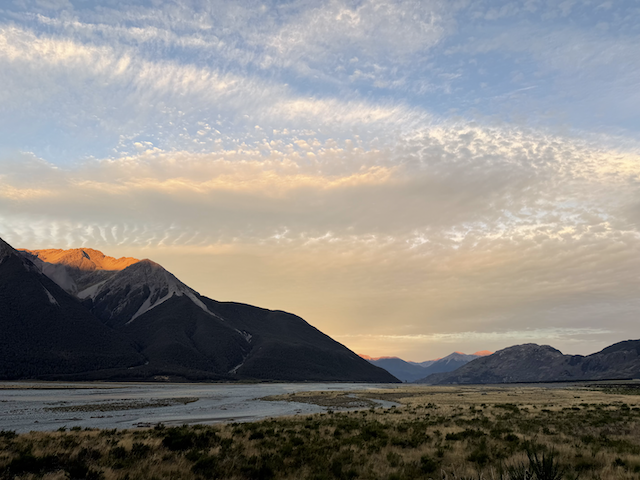
New Zealand is sits where the Pacific Plate and the Australian Plate meet, and their movement continuously deforms the Earth’s crust. Tectonic plates are giant, slowly moving puzzle pieces made of thick rock that the continents and oceans sit on. They form the Earth’s strong outer surface and rest on top of a softer, very hot layer called the mantle, which is made of melted rock similar to the lava that comes out of volcanoes. At their edges, the plates push and bump against each other.
Because of this, the landscape is steep, dramatic and constantly changing. Mountains rise, faults shift and coastlines are reshaped by both uplift and erosion. The way people live in New Zealand is closely connected to this geology. From where cities are built to how electricity is generated, the physical environment plays an important role in daily life.
New Zealand is special because it sits directly on a plate boundary. In the South Island, the Pacific and Australian plates slide past each other along a large crack in the Earth’s crust called the Alpine Fault. In the North Island, the Pacific Plate is being pushed beneath the Australian Plate in a process called subduction.