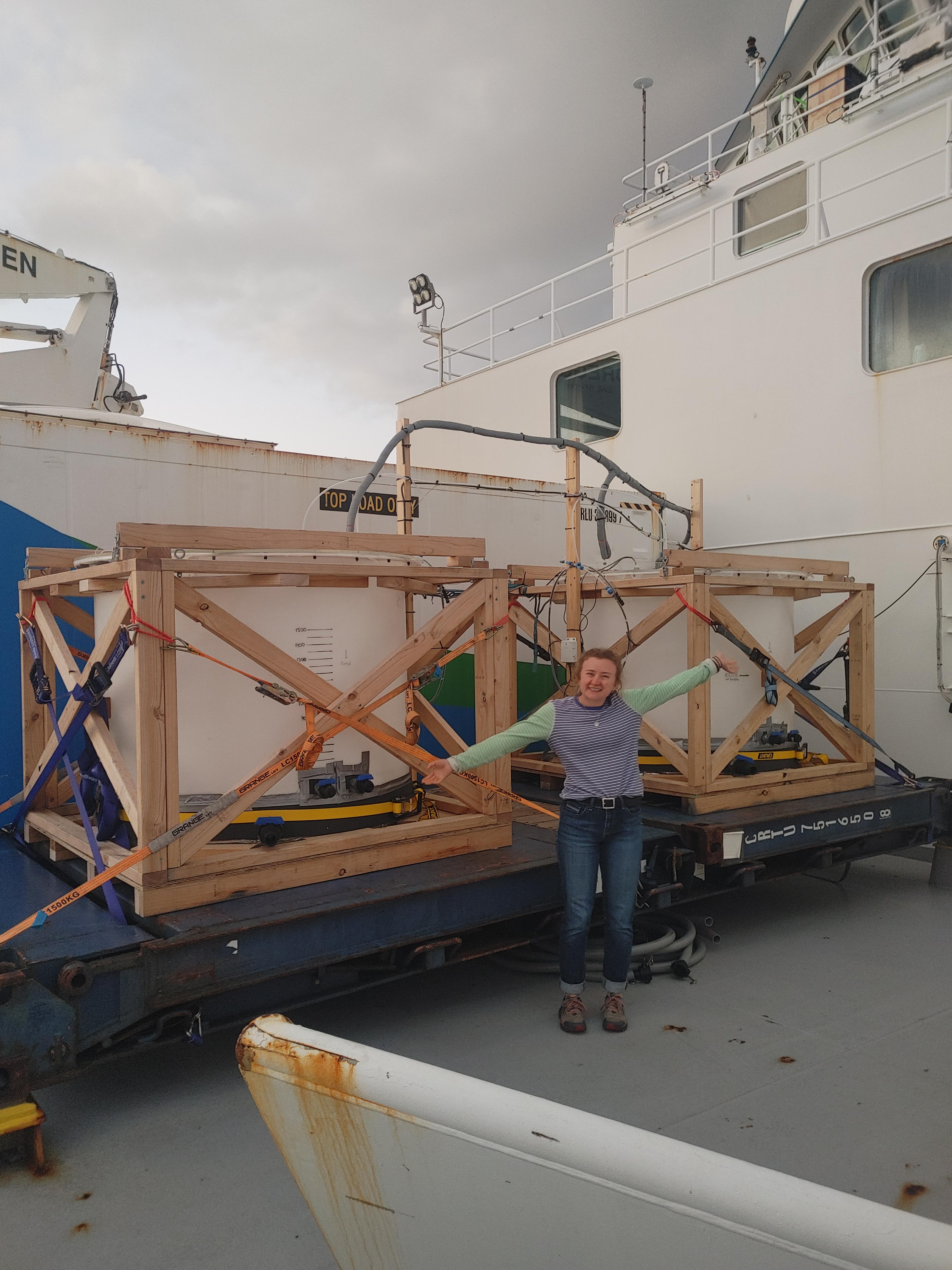
One of the scientific tools that we use to find biologically active areas in the ocean is ocean color from satellite data. Phytoplankton go through lifecycles of blooming and dying off so areas with a lot of biology change with time. During our voyage, we passed through an area that had a lot of biology. We jokingly called it "The Blob" on the voyage. While we were in the area, we started an experiment where we filled some large tanks on the deck with sea water. We then changed one variable, the amount of iron, in the two tanks. Over a two-week period, we studied how the amount of iron affected the biology in the tanks and the properties of the aerosols inside the tank. The data will be analyzed to see how the biology is linked to the aerosols and other properties in the system.
The phytoplankton and bacteria in the Southern Ocean make a product called Dimethyl sulfide or DMS. Some of the DMS enters the atmosphere and goes through chemical processes that make aerosols that water can condense on. These aerosols are some of the cloud condensation nuclei or CCN that form clouds.
The one of the most interesting things about clouds in the Southern Ocean is that almost all these CCN come from natural processes. Back in Salt Lake we have a lot of different aerosols that contribute to CCN like smoke, exhaust, and dust. It can be hard to pick out the natural processes that form clouds when you are in a polluted environment. In the Southern Ocean, we have very little pollution which allows us to see the natural processes and through the data we are collecting. With collaboration with the other science teams on board, we are investigating how the biology influences these natural cloud processes.