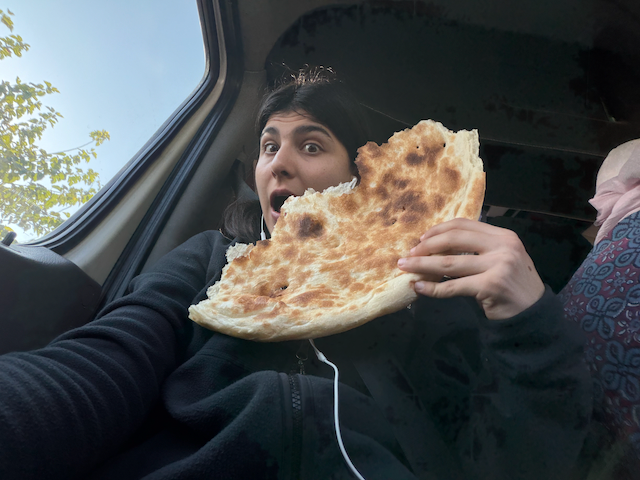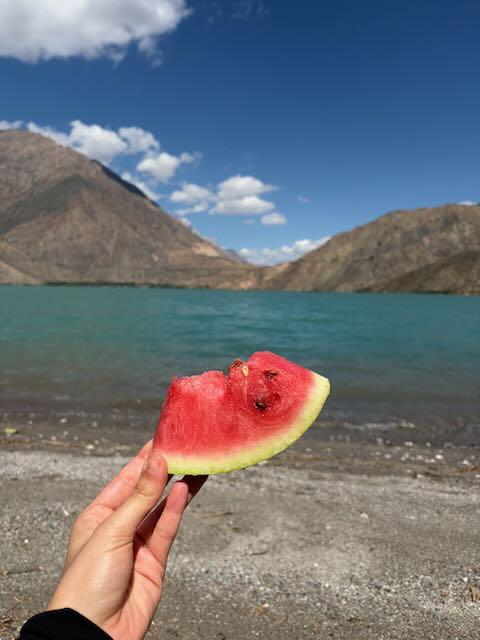
I especially love the warm, freshly baked bread, and I've become a huge fan of Tajikistan's unbelievably sweet watermelons. They taste like summer!
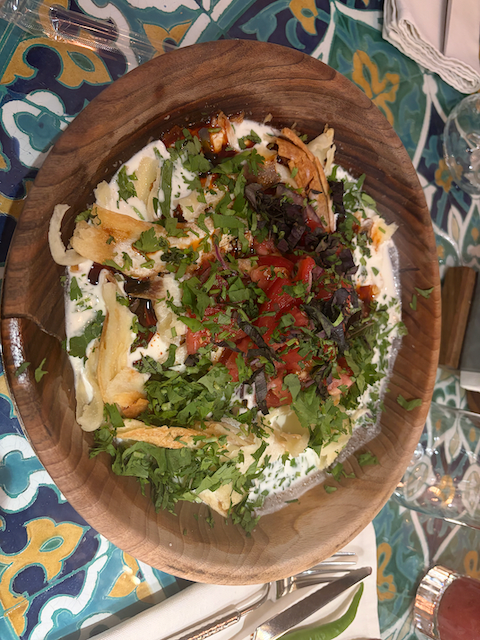
Qurutob has been one of my most interesting discoveries. It has a very distinctive sour flavor, so it can be an acquired taste. But it's beloved by many Tajik families, and I've grown to love it too!
Even though being vegetarian has sometimes made eating in Tajikistan challenging, it has also led to some of my favorite moments.
Traditional Tajik dishes use a variety of interesting cooking methods, many of which are different from those I was familiar with in America.
For example, mantu are typically filled with ground meat and onions, then steamed until the dough becomes soft. My host mom prepared them the same way, but substituted pumpkin for the meat.
Osh is often cooked in a giant pot called a kazan, sometimes over an outdoor fire. The rice, carrots, onions, oil, and usually meat are cooked together to create the dish. My friend once made Osh in a big pot over a fire we had to build ourselves.
Bread is another important part of Tajik cooking. In nonvoykhonas, bakers prepare traditional round loaves of bread, often baking them against the hot walls of a clay oven called a tandoor. The bakeries make bread throughout the day, so when you buy some, it's often still warm! A big piece of bread normally costs two to four somoni, or about 20 to 40 US cents.
Bread is also an important part of Tajik hospitality. It's served with nearly every meal and is often placed in the center of the table for everyone to share.