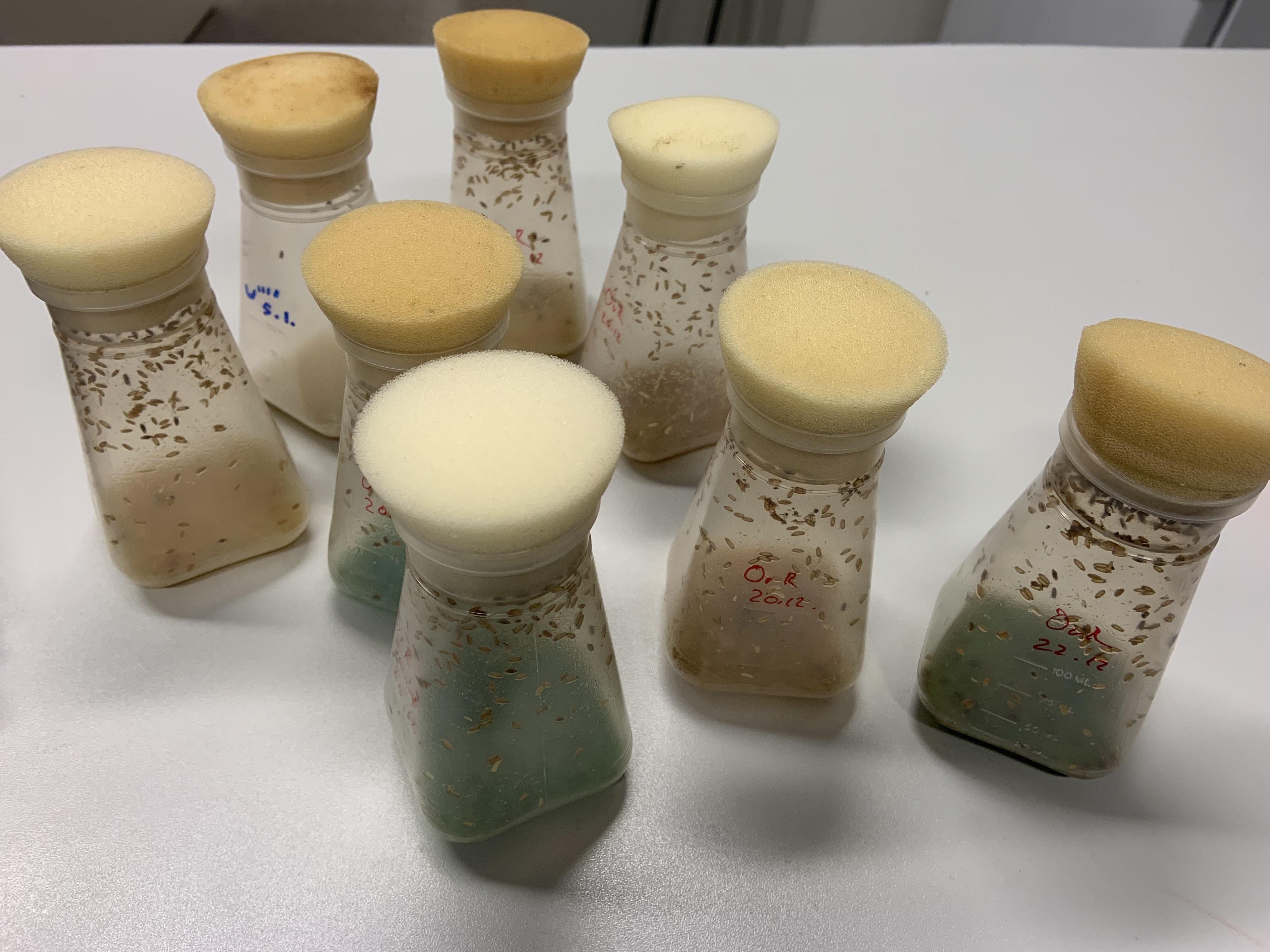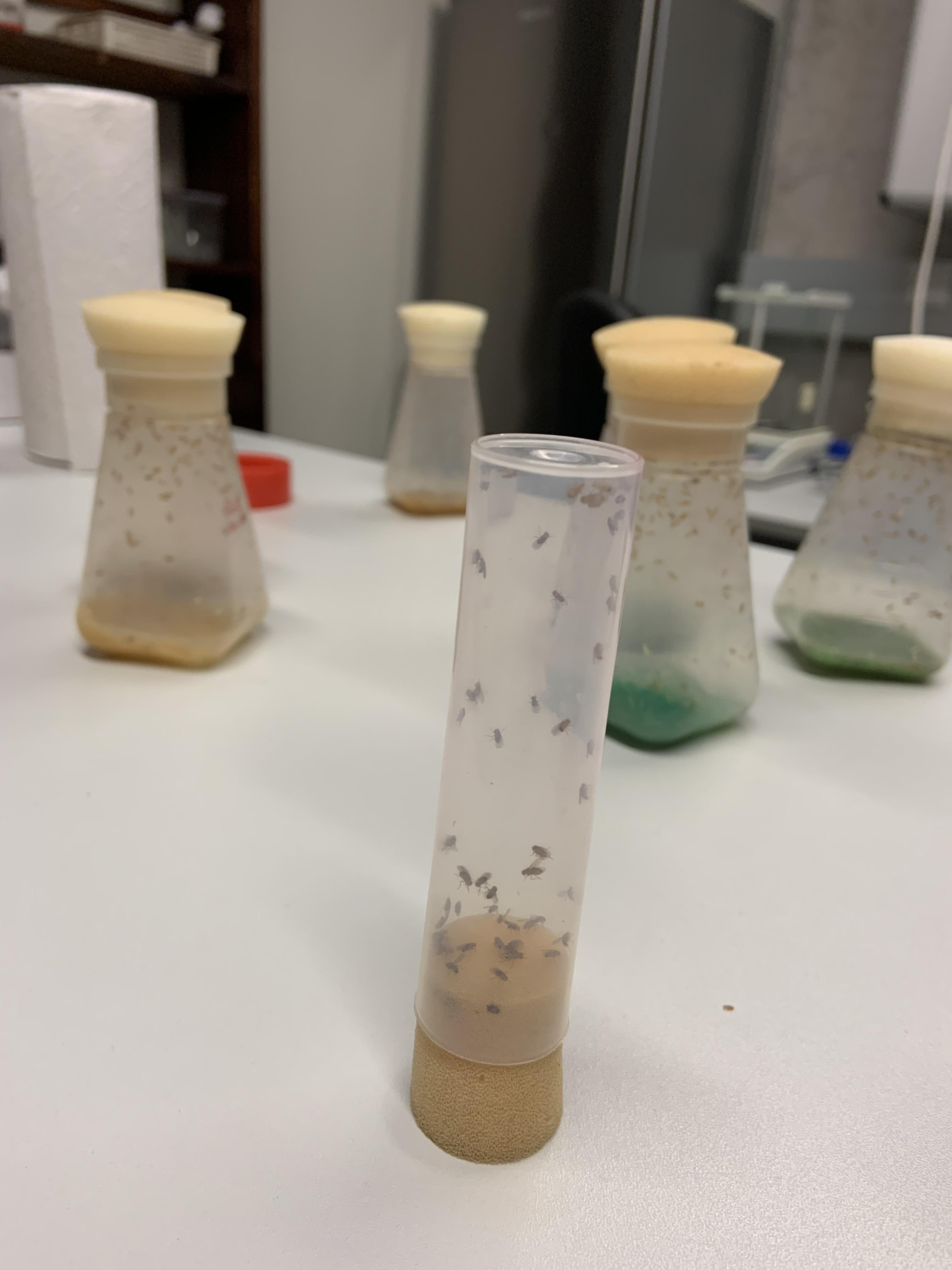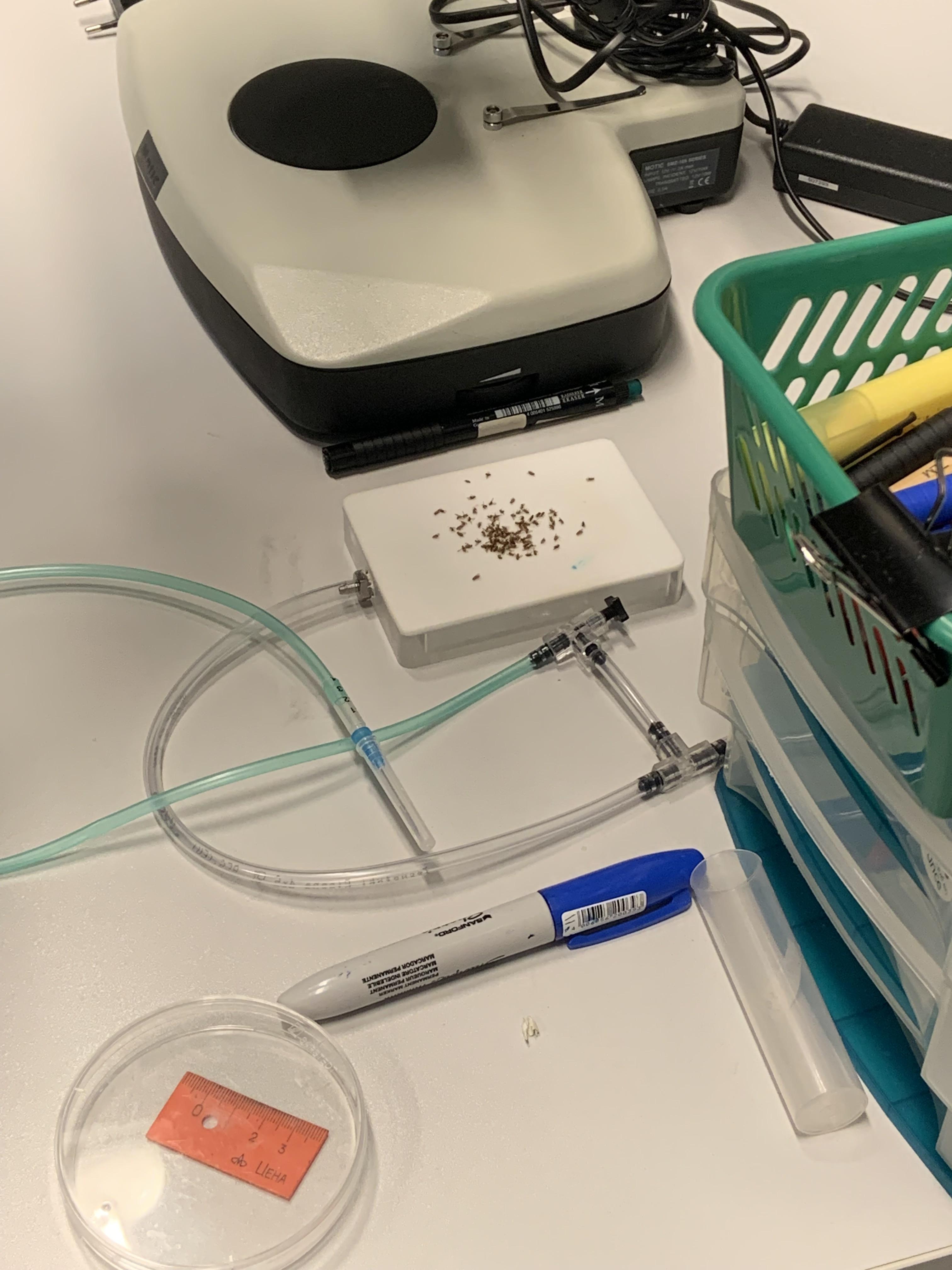
In these vials, there is a food mixture that is basically cornmeal, water, sugar and yeast, so you could technically eat this, too! We separate out males and females by anesthetizing them on a carbon dioxide-circulated plate. Flies can be transferred from vial to vial through a process called gravity inversion reaction. This means that flies tend to move against the pull of gravity. We turn vials upside down, the flies gather at the top, we remove the plugs, put the empty vial in line with the populated vial to create a closed system and then we flip the vials so that the flies go against gravity into the new vial.
Specifically, we are investigating the ecological theory that is pace-of-life. In short, this theory posits that when an individual organism is stressed during its developmental phases of life, it will develop and reproduce quicker, and live shorter, than individuals who are not under the same amount of stress. Applying this to our system, the presence of spiders (stress) during the development of flies (eggs to larva to pupa to fly) will lead to quicker time to reproduction and quicker time to death than for flies not exposed to spiders.
To do this, we are placing vials that are just containing fly eggs into either a container with or without a spider. We are checking in daily to watch the progression and development of these eggs, which initially started out in the exact same source environment. We predict the ones with the spiders will develop more quickly and reproduce more quickly (they do this in the same vial they hatched from!). The spiders will be well fed, so they will not be inclined to prey upon flies in their containers, but their presence still induces a stress-response in flies.