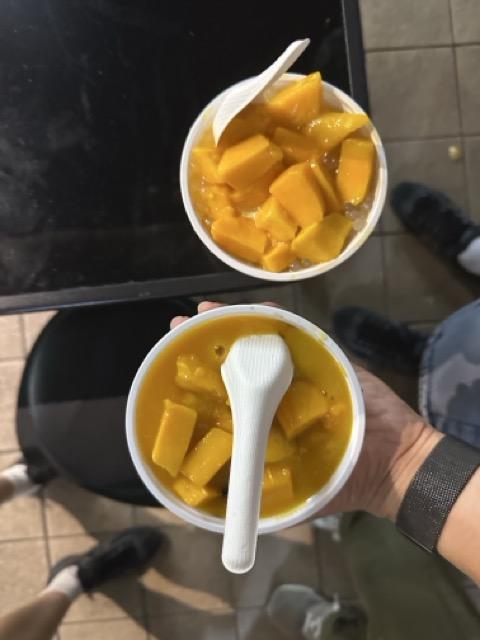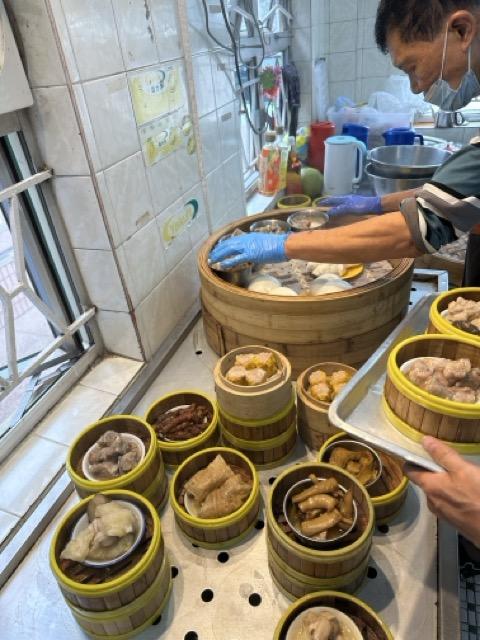
At yum cha, which literally means 'drink tea,' the table fills with small shared dishes like pork (jyu yuk), sticky rice (no mai gai), and tofu pudding (dau fu faa). Yum cha is usually a late morning meal, between breakfast and lunch. For dessert, light, sweet soups and puddings like green bean soup (luk dau saa), mango pomelo sago (yeung chi kam lo), and snowy white fungus with papaya (syut yi muk gwa tong sui).
I felt unbelievably happy and full. It is loud, crowded, and a little chaotic, and that is exactly what makes it fun.
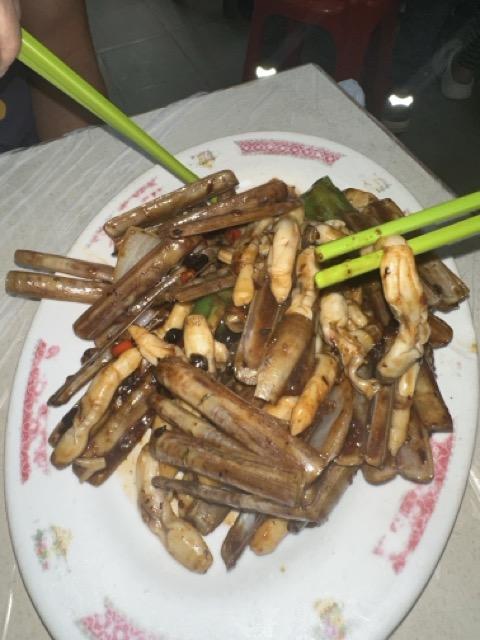
Everything is cooked in a wok over a very hot flame, to order, and it comes out fast. The cook tosses the food high in the air, and the fire licks the edges of the wok. That is what gives the dishes their smoky flavor, called wok hei, the breath of the wok. The eggplant is stir-fried and served bubbling in its claypot, and the mussels are tossed with soybean and pepper until they are coated in the sauce. Nothing is slow. It is fast, hot, and loud, and that is the point.
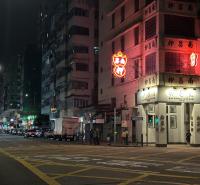
Hong Kong is a crowded city. Flats here are small and kitchens are tiny, so people have always eaten out on the streets together. Dai pai dongs started as licensed street stalls in the 1940s, but only a handful are left now. The ingredients come from the wet markets nearby. Other foods also reveal parts of Hong Kong's history. The cha chaan teng mixes Cantonese and Western food.