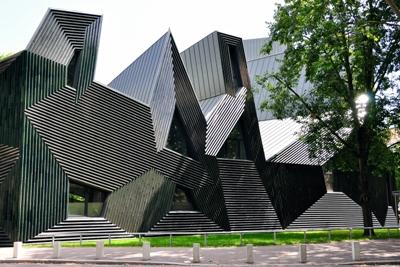
Oddly enough, most of the current Jewish community in Mainz and the rest of Germany is not directly connected to this history. After the collapse of the Soviet Union, which was a massive empire of 15 countries that no longer exists, more than 200,000 Soviet Jews immigrated to Germany, making up the overwhelming majority of Germany's Jewish population. I saw this first-hand when I went to Yom Kippur services at the Mainz Neue Synagoge (New Mainz Synagogue), where prayer books were printed in both German and Russian, and many of the congregation members spoke in a mixture of German and Russian with a few Hebrew words sprinkled in.
Overall, my discussions with Germans about Jewish identity and German history have been very positive. My landlord, for example, whose father served in the German military during World War II, has talked to me a lot about how she and other Germans of her generation (born in the two decades following the war) reckoned with their family members’ actions and responsibility while also being able to mourn their own wartime losses. Today, German culture emphasizes multiculturalism and respect for everyone, regardless of race, religion, or ethnicity. They have learned from the past.