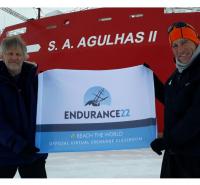
There is emergency medical care available aboard the S.A. Agulhas II, but what is a simple fix at a U.S. doctor’s office can become a life-threatening emergency when you’re hundreds of miles away from the nearest hospital in the Weddell Sea. At the end of my appointment, my doctor declared me “medically uninteresting” and signed all the forms I needed. I have sent them to the National Maritime Center at the U.S. Coast Guard, and I’ll be eagerly watching the mail for my medical certificate in the days to come.
Another way that I’m preparing for the expedition is to take a 12-hour PST (Personal Survival Techniques) class. The S.A. Agulhas II is a modern ship with all the modern safety equipment, including lifeboats, immersion suits (imagine a space suit that is built to keep you relatively warm and afloat in icy waters), and satellite communications, but in order for those things to be useful, expedition participants need to know how to use them in the event of an emergency. For that training, I turned to Captain Bill Russell at the Chicago Maritime School.
During the classroom portion of my PST course, Captain Russell taught me a number of ways to protect myself in the event of an emergency at sea. We talked about lifesaving equipment, emergency communications (all the ways ships can request help), survival techniques in the open sea, and how to safely abandon ship or help during a helicopter rescue. I listened very closely and asked a lot of questions--this new information could be the difference between life and death in the unlikely event of an emergency. Amongst other tasks, I had to correctly put on a full-body immersion suit in less than two minutes.