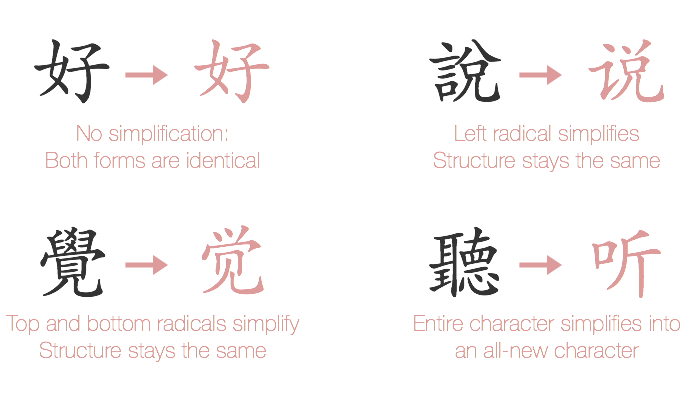
The government didn't want to fully get rid of Traditional Chinese because of the writing system's significance to Chinese culture, but they needed an easier system to quickly raise these literacy rates. Consequently, Simplified was devised by reducing the number of strokes that traditional characters had while retaining their meaning. For example, the traditional characters 幾個 Jǐ gè together mean “several". In Simplified, it is written as 几个. Notice how the characters were changed and made a lot easier to write. Usually, the changes are not this obvious, as in the case of "mother" 媽 mā becoming 妈.
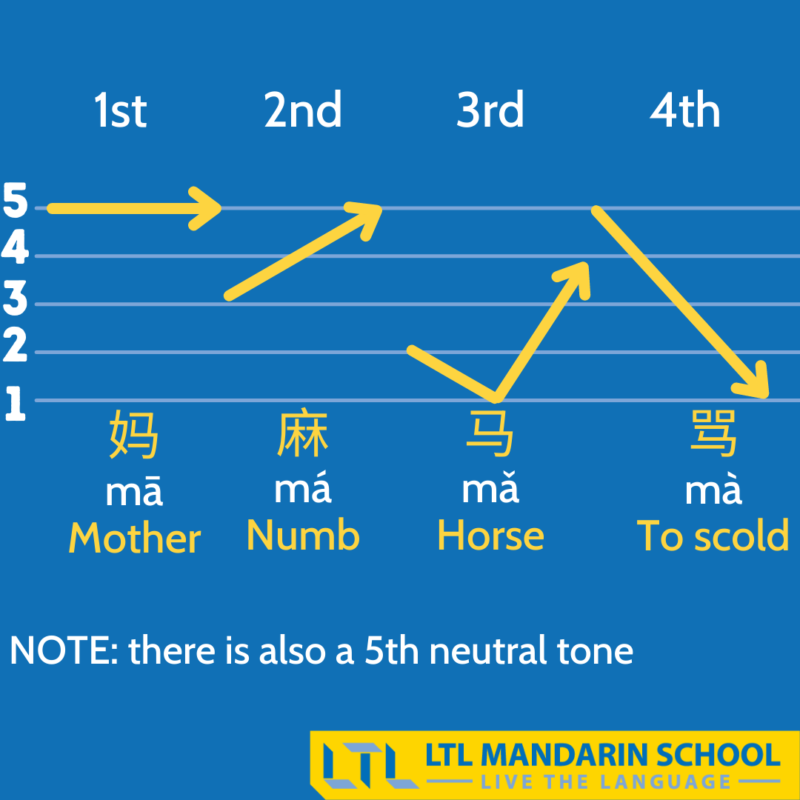
Secondly, when I write the pronunciations of the characters in English, you'll notice that there are tone marks on top of the vowels. Your tone when speaking in Chinese can affect the meaning of the words you say. Mandarin Chinese has four tones plus one neutral tone: ā (high pitch), ǎ (low pitch), à (falling pitch like when you speak with an exclamation), á (rising pitch like when you ask a question), a. Tones are the hardest part of the language for English speakers to learn when they practice speaking because they aren't used to tonal languages. Punjabi is another tonal language.
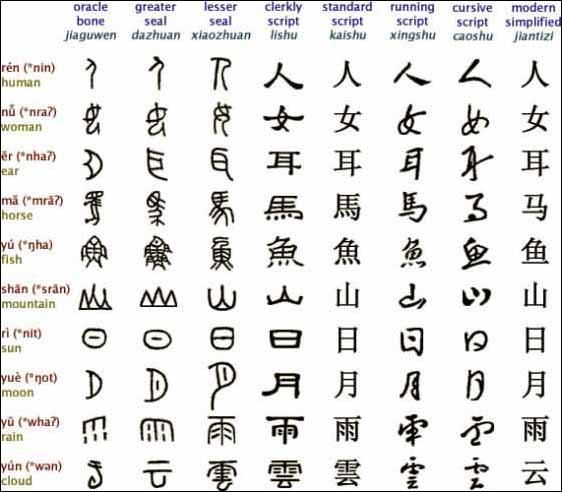
Lastly, there is a method for memorizing Chinese characters that even Chinese teachers subconsciously fail to recognize. Latin, Katakana Japanese, Korean, Devanagari, Arabic and other writing systems all have letters that only convey a phonetic component. Multiple letters together create a word. Chinese is different in that every character represents a "word", but you don't have individual letters that combine together to make a character.