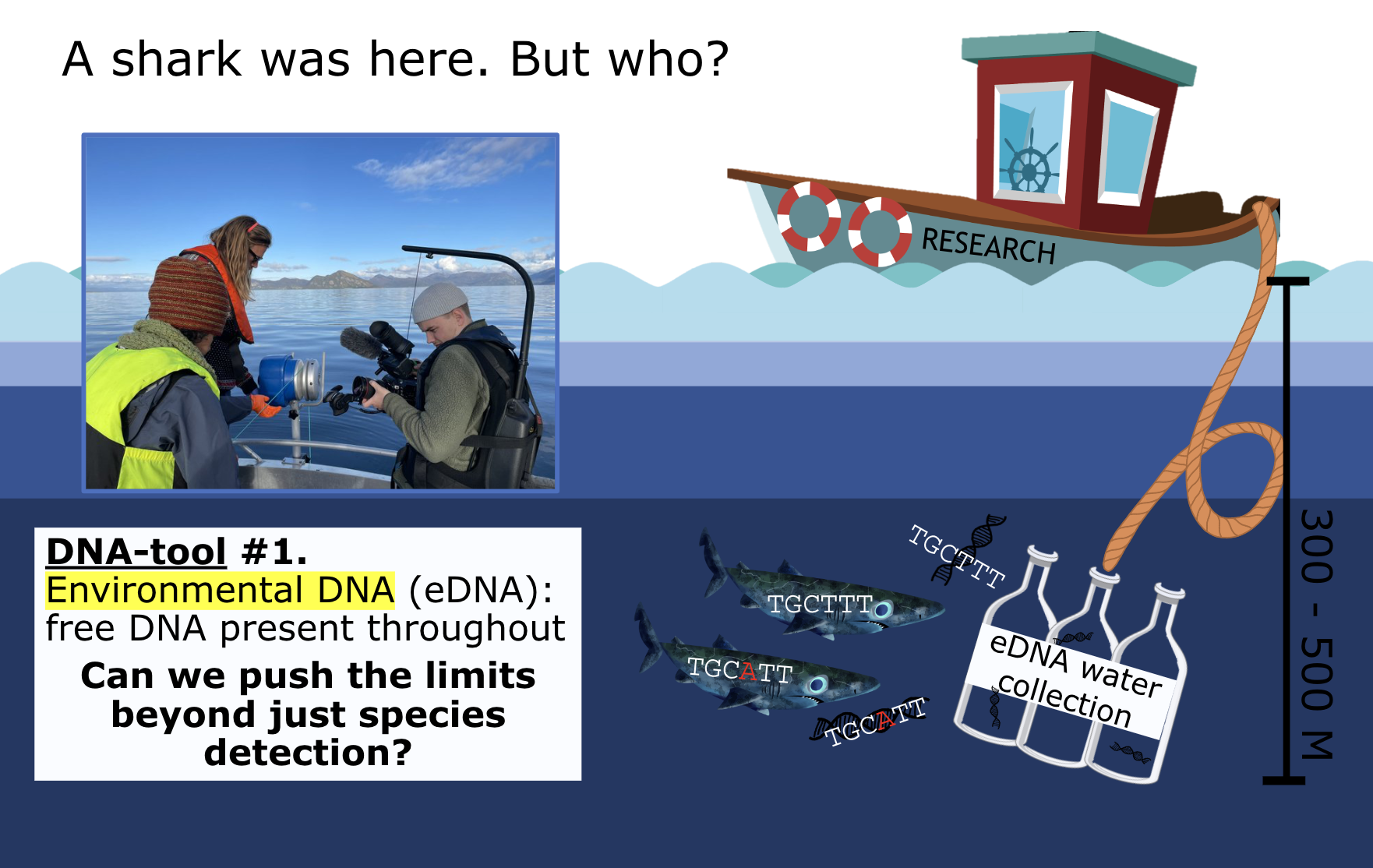
In this journal article, I will explain my first DNA tool in more depth. When water sampling, we use a capture device that we drop, let float down and trap water at a certain depth. With the environmental DNA (eDNA) floating in these water samples, I hope to determine if our species of interest, the Greenland shark, is present in the fjord, but I would also like to push these DNA tools further. I want to say that the shark DNA in the sample belongs to one shark family or multiple. What could co-occuring, unrelated individuals in the same sample tell us? Why would a tool like this be exciting for scientists? Specific and personal information like this will be needed to make informed, real-time conservation decisions in the future.
Before arriving in Tromsø, the Genetics group at the UiT had already collected and sequenced the mitochondrial DNA (mtDNA) from many shark tissue samples. Because of these previous efforts, I created a database and measured the relatedness between individuals based on variability in single nucleotide polymorphisms (SNPs). These small changes in DNA are passed down between family members.